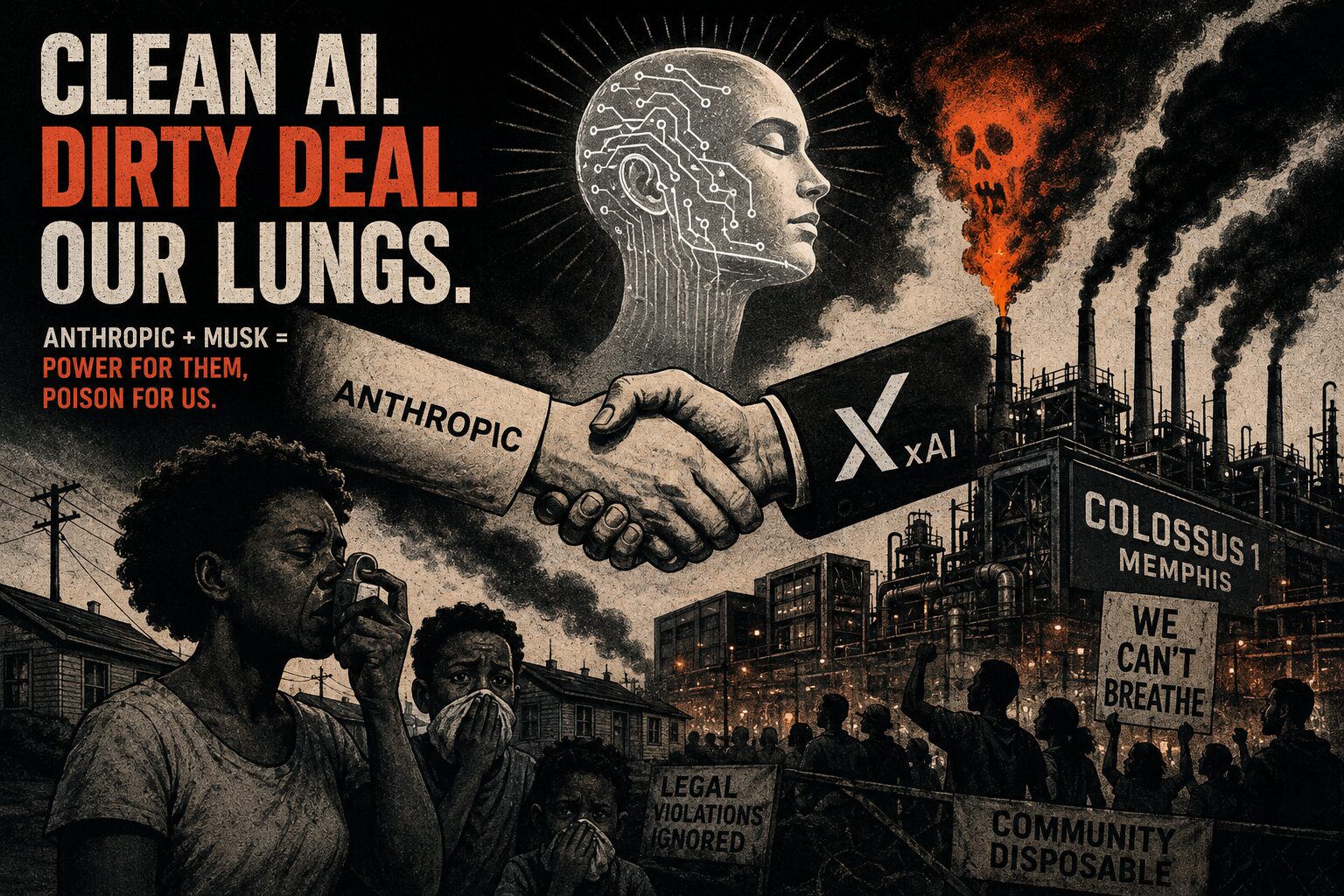
When the news broke on May 6, 2026, that Anthropic had struck a deal with Elon Musk’s SpaceXAI to use the infamous Colossus 1 supercomputer in Memphis, it wasn’t just another tech partnership. It was a collision of Silicon Valley’s loftiest AI safety promises and the grim reality of unregulated, gas‑guzzling infrastructure. The same system that now runs Claude - the chatbot users turn to for thoughtful, “constitutional” AI - is powered by dozens of natural gas turbines that have been spewing toxic pollution into a community already choking on environmental racism.
This is the story of how Anthropic chose compute over conscience.
The Supercomputer That Stinks
Colossus 1 is not a symbol of sleek, carbon‑neutral technology. To meet its monstrous energy demand, SpaceXAI (the merged entity of SpaceX and xAI) installed over 35 mobile gas‑turbine generators, operating them for more than a year without the required air permits. These turbines burn natural gas directly on site, releasing a cocktail of nitrogen oxides, formaldehyde, benzene, and lung‑damaging particulate matter (PM2.5). Residents of Southwest Memphis have long complained about the acrid, “rotten egg” odor and skyrocketing rates of asthma attacks - a toxic plume added to a neighborhood where the cancer risk is already four times the U.S. average.
Federal regulators eventually stepped in. In January 2026, the Environmental Protection Agency ruled that xAI (now SpaceXAI) had been operating illegally. The facility’s annual release of hazardous air pollutants from the turbines was estimated at 11.51 tons, well above the 10‑ton threshold that triggers strict permitting. Despite this, the generators kept spinning, and the company’s lawyers simply leaned on a temporary loophole.
So when Anthropic CEO Dario Amodei announced that “all of Claude’s operations at scale” would move onto this hardware, it meant one thing: every conversation with Claude now literally runs on the fumes of unchecked fossil fuel burning.
An Ethical Tear in the Fabric
For a company that built its brand on being the adult in the AI room, the move is staggering. Anthropic’s constitution for Claude explicitly speaks of avoiding harm and respecting the planet. Until February 2026, its own Responsible Scaling Policy (RSP) contained language that would have prohibited a partnership like this: if safety conditions weren’t met, the company would not scale further. But a quiet revision - RSP 3.0 - surgically removed that commitment. Jared Kaplan, Anthropic’s chief scientist, defended the change by saying that unilaterally slowing down “wouldn’t help anyone” while competitors race ahead.
The internal fallout was immediate. The company’s head of alignment resigned, writing in a public post, “The world is in danger.” Employees grumbled about the hypocrisy of a “safety‑first” lab silently erasing its own red lines just before jumping into bed with Elon Musk.
Why a “Safe” AI Lab Drank from the Gas Pump
The proximate cause was hunger. Claude had exploded in popularity, and developers were hammering Anthropic with complaints about rate limits and API instability. Finding vast, idle GPU clusters on short notice is almost impossible - unless you knock on the door of the man who bragged that Colossus was built in 122 days. Musk’s 220,000‑GPU monster was sitting there, already wired and burning fuel.
But the deeper reason is the brutal math of AI economics. Anthropic, valued at $900 billion, needed to show it could sustain growth. Its previous reliance on ethical, cloud‑based compute from Google and Amazon was hitting physical ceilings. And after a bitter dispute with the Pentagon - where Anthropic refused to lift restrictions on autonomous weapons and the U.S. government threatened to designate the company a “supply chain risk” - the window for morally pure partnerships was closing fast. In that context, Musk’s unpermitted gas farm looked less like a sin and more like a lifeline.
The Man Who Cried “Misanthropic Evil”
The personal twist is almost satirical. Not long ago, Elon Musk was calling Claude “misanthropic and evil,” warning that Anthropic’s AI would end humanity. After the deal, his tone transformed overnight. Musk posted that the Anthropic leadership had “passed his evil detection test” and that he now believed in their commitment to “critical self‑reflection.” He even secured a unilateral right to pull the plug on Anthropic’s compute if he ever judges their models are dangerous - giving one man, with his own competing Grok AI, a kill switch over a rival.
The climate activist in Musk, the one who built Tesla into an electric vehicle giant, was nowhere to be seen. Instead, Colossus operates with an annual carbon footprint larger than that of a full‑scale coal plant, all in the name of out‑computing everyone else.
The Unheard Voices of Memphis
For the people of Southwest Memphis, the Anthropic deal is salt in a long‑festering wound. Community organizers, who had already filed multiple lawsuits over air quality, staged fresh protests outside the Colossus gates the day the partnership was announced. Their message was blunt: “Your ethical AI is making our kids sick.”
Local data showed a sharp rise in emergency room visits for respiratory distress since the turbines first spun up. And yet, neither Anthropic nor SpaceXAI has offered the community a seat at the table or a plan to mitigate the damage.
What This Means for AI Ethics Going Forward
The Anthropic‑Musk deal is not an aberration; it is a preview. As AI models become hungrier for compute, the pressure to lower the bar - on environmental standards, on labor practices, on safety protocols - will only intensify. If the world’s most vocal “safety” lab can hand‑wave its own principles for a few hundred megawatts of gas‑powered silicon, then the entire notion of voluntary ethical restraint in AI is on life support.
Claude may now answer your questions faster. But behind each response is a cloud of formaldehyde and a community that never consented to be the sacrifice zone for artificial intelligence.
The Beast on Boeingshire Road
To understand the scale of the contradiction, you must first understand Colossus 1. It is not a sleek, liquid-cooled data center in a Scandinavian fjord. It is a rushed, brute-force monument to accelerationism. When Elon Musk first announced its construction in 2024, he boasted that the entire 100,000-GPU cluster was brought online in just 122 days - a speed record that civil engineers warned would come with corners cut. By 2026, the facility had swelled to over 220,000 of Nvidia’s most advanced chips (H100, H200, and GB200), demanding a constant 300 megawatts of power. The local grid could not supply it. So Musk’s team brought in the turbines.
We are not talking about a handful of backup generators. At peak, more than 35 General Electric turbine units - essentially jet engines bolted to concrete pads - were arrayed across the site, burning natural gas around the clock. Because they were classified as “temporary” equipment by a legal gray zone, they required no federal air permit, no comprehensive environmental review, and no public hearing. The result, documented by air quality monitors and citizen scientists, was a toxic bouquet: nitrogen oxides that trigger asthma and chronic lung disease, formaldehyde classified as a human carcinogen, and benzene wafting over playgrounds. Fine particulate matter (PM2.5) - the kind that burrows deep into the bloodstream - regularly spikes to levels the EPA labels hazardous.
The Southern Environmental Law Center, representing local groups, calculated that the annual hazardous air pollutant emissions from just the turbines exceeded 11.51 tons - crashing through the EPA’s 10-ton major source threshold that should have mandated rigorous controls. A separate analysis found the facility’s carbon footprint surpasses that of a large coal-fired power plant. In January 2026, the EPA finally issued a formal finding: SpaceXAI (the merged entity of SpaceX and xAI) had been operating the turbines illegally. Yet the injunction was narrow, the turbines kept humming, and the company’s legal strategy essentially ran out the clock. The smell never left.
The Community as a Sacrifice Zone
Southwest Memphis is not a random location. It is a textbook case of environmental racism. The zip code 38106 is more than 90% Black, with a poverty rate well above the national average. Generations have battled the cumulative effects of heavy industry, brownfields, and highway pollution. According to the EPA’s own Environmental Justice Screening Tool, the cancer risk from air toxins in this census tract is in the 95th percentile nationally - independent health surveys suggest it is four times the U.S. mean.
Since the turbines started spinning, local physicians have reported a significant uptick in emergency room visits for acute respiratory distress, particularly among children and the elderly. Community organizer Kendra Williams of the Memphis Clean Air Coalition has been curating a “smell diary” - hundreds of timestamped entries from neighbors documenting headaches, nosebleeds, and nausea. “They talk about AI saving the world, but they’re destroying our world right now,” Williams said in an interview outside the Colossus perimeter fence, where a semi-permanent protest camp of folding chairs and gas masks now stands. “Anthropic knew all of this. They came anyway.”
The lawsuits were already stacking up. A class-action suit on behalf of residents alleges nuisance, negligence, and civil rights violations under Title VI of the Civil Rights Act. Another filing by the Memphis Community Against Pollution seeks an immediate shutdown of the unpermitted turbines. The ink on those subpoenas was barely dry when Anthropic’s logo was added to the parties of interest. The community response was swift: the day the deal was announced, protesters blockaded the facility’s main gate, carrying placards that read, “Your Ethical AI Made My Child Sick.”
The Great Policy Erasure
Internally, the groundwork for this partnership was laid months earlier, in a small edit that destroyed a cornerstone of Anthropic’s identity. For years, the company’s Responsible Scaling Policy (RSP) served as a quasi-sacred text. The RSP 2.0 stated that if the company could not implement adequate safety measures for a given tier of AI capability, it would halt further scaling. It was this promise that allowed Anthropic to attract top safety researchers, to testify credibly before Congress, and to position Claude as the trustworthy alternative to ChatGPT and Grok.
In late February 2026, RSP 3.0 was quietly published on a Friday afternoon - a classic news-dump timing. The commitment to stop scaling was gone. In its place was a far softer pledge to “exercise caution” and “consult stakeholders,” language that a company lawyer might use to justify almost anything. Jared Kaplan, Anthropic’s co-founder and chief scientist, explained the revision in an internal all-hands: “A unilateral pause wouldn’t help anyone. The race dynamic means others would simply fill the gap, potentially with less safe systems.”
The reaction among the research staff was volcanic. A respected member of the alignment team resigned that weekend, posting a short but devastating note to his personal blog: “I joined to build AI that wouldn’t destroy the world. I’m leaving because the company just made it easier.” The post concluded with the line that ricocheted across AI forums: “The world is in danger.” Employees privately shared screenshots of the old versus new policy text, circled the excised sentences, and peppered leadership with questions on Blind and internal Slack channels. Morale cratered. Yet the policy change stood, and with it, the legal and ethical barrier to embracing Colossus at full throttle dissolved.
The Pentagon Ultimatum and the Squeeze
Why did Anthropic feel it had no choice? The missing piece of the puzzle sits in the halls of the Pentagon. For two years, Anthropic had been engaged in a delicate dance with the U.S. Department of Defense over the use of Claude in military applications. Defense officials, eager to integrate advanced LLMs into intelligence analysis, logistics, and even battlefield decision-support systems, pushed Anthropic to remove its blanket prohibition on autonomous weapons and other direct harm applications.
Anthropic’s leadership, led by CEO Dario Amodei, resisted. Amodei had repeatedly stated that AI should not be used to take human life. The stalemate infuriated Pentagon hawks. In a classified memo leaked to tech press in early 2026, the DoD threatened to designate Anthropic as a “risk to the defense industrial supply chain” - a bureaucratic nuclear option that would effectively blacklist the company from all federal contracts, subcontracts, and even many cloud service agreements used by government agencies. Given that federal spending is a cornerstone of AI revenue projections, the threat was existential.
The Pentagon pressure created a two-front war for Anthropic. On one front, the government was squeezing them to abandon ethical constraints. On the other, the voluntary safety culture that kept investors and talent loyal was eroding. Caught between losing its government market and violating its moral promises, the company chose a third path: downplay the Pentagon fight, pivot to commercial scale at any cost, and seek a compute partner who would ask no questions. That partner was Elon Musk.
From “Misanthropic Evil” to “Critical Self-Reflection”
The personal element borders on absurdist theater. Elon Musk’s previous pronouncements about Anthropic were venomous. In social media posts, interviews, and a memorable podcast rant, he referred to Claude as “misanthropic and evil,” warning that it would inevitably produce an AI that decides humanity is a net negative and acts accordingly. He amplified the #StopAnthropic hashtag and publicly urged a global moratorium on the kind of recursive self-improvement research Anthropic was known for.
All that changed after a series of private dinners between Musk, Amodei, and Anthropic’s president Daniela Amodei. Details of those meetings are closely held, but what leaked suggests a mutual realpolitik dawning. Musk needed a flagship tenant to justify Colossus’s gargantuan capital expenditure to SpaceXAI investors on the eve of a projected $1.75 trillion IPO. Anthropic needed 300 megawatts immediately. The deal was simple: compute for money, and Musk gets to claim his supercomputer is now “multitenant” and thus a commercially viable asset, not a vanity project.
Musk’s public tone flipped overnight. “Met with the Anthropic team, they did not activate my evil detection threshold,” he posted. He praised their capacity for “critical self-reflection,” a coded nod to the very constitutional AI framework he once reviled. He even inserted a bizarre clause into the contract: Musk retains the unilateral right to revoke Anthropic’s compute access instantly if he personally judges that their models pose an existential threat. A single unelected billionaire - who runs a direct AI competitor - now holds a kill switch over a rival lab. Antitrust experts and AI ethicists alike choked on their coffee.
The Bitter Irony of “Dreaming” on a Gas Cloud
With the new compute came a host of product announcements carefully orchestrated to distract from the origin story. Anthropic lifted rate limits on Claude Code, doubled API throughput for Claude Opus, and unveiled a new feature called Dreaming. The feature lets Claude run continuous background analysis on its own internal state during idle cycles, finding patterns, self-correcting errors, and preserving long-term context across sessions.
It sounds magical - and it is, technically. But the symbolism is devastating. The AI is now literally “dreaming” on the back of a fossil-fuel furnace that is depriving real people of their own peaceful sleep. A system designed for introspection is running on infrastructure that refuses to introspect about its own harm. “Claude gets to dream while our kids wake up wheezing,” noted one protest sign, a phrase that captures this disconnect perfectly.
The Wider Reckoning for AI Ethics
The Anthropic-Musk deal is not a one-off scandal; it is a harbinger. As language models scale to trillion-parameter architectures, the energy appetite of AI is projected to surpass that of small nations. The choice for labs will become increasingly stark: accept “dirty” but available power, or fall behind. If the laboratory most famous for saying “slow down” just strapped a rocket engine to a methane flare, what message does that send to every other boardroom? It signals that voluntary ethical railings are decorational, easily removed when the competitive pressure gets hot.
Investors appear to agree. AI venture capital funds have begun explicitly modeling “compute pragmatism” into their risk assessments, rewarding startups that avoid hard safety commitments. Meanwhile, the board members and non-profit trustees of Anthropic - those chartered with protecting the company’s mission over profits - have remained conspicuously silent. Their website still speaks of “Responsible Scaling” and “benefiting humanity.” No footnote mentions the 35 gas turbines.
Where Memphis Goes From Here
The human cost continues to mount. The Memphis City Council, once paralyzed by the promise of tech jobs, has started holding weekly hearings. In a terse statement, the council’s health committee chair acknowledged that “big tech is welcome, but not when it poisons the air.” The promise of a community benefits fund - floated by SpaceXAI in a PR charm offensive - has so far yielded nothing but a draft proposal with no funding commitments.
Legal experts believe the EPA finding of illegal operation opens the door to enforcement actions that could fine SpaceXAI millions per day. A worst-case scenario for the partnership would be a court-ordered shutdown of the turbines, leaving Anthropic scrambling for replacement compute and triggering breaches of service level agreements with its own enterprise clients. Yet until that order comes, the generators roar on.
The real cost is borne by people like Marlene Jackson, a 67-year-old retiree who has lived in Southwest Memphis her entire life. “I voted for progress. I wanted my grandkids to see a future with new technology,” she said, gesturing toward the Colossus perimeter. “But not like this. Never like this. They’re burning our future to build theirs.”
Conclusion: The Smell of Ethical Decay
A whiff of moral decay now clings to Claude’s every human-sounding response. The well-crafted paragraphs, the gentle disclaimers, the careful refusals to cause harm - all are generated by chips that are cooled by the air a community is forced to choke on. The ethical brand that thousands of engineers, researchers, and idealists poured their careers into has been traded for a few hundred megawatts.
This is the ultimate test for the AI safety movement: not whether machines will turn on us, but whether the people building them will turn on their own principles when the stakes get high enough. In Memphis, that test has already failed. The turbines spin, the gas flares, and Claude dreams on. The smell of progress, it turns out, is indistinguishable from the smell of burning away one’s own integrity.
Sources: